StratabenchAerospace test systems
Aerospace flow and pressure test equipment plumbed in stainless steel

Custom aerospace test equipment · Built from your CMM or ATP

Custom aerospace test equipment,
engineered around your component.

We design and build flow benches, pressure test stands, functional test equipment, fixtures, and ground support equipment from your CMM, ATP, drawing, or test requirement — fuel, hydraulic, lubrication and oil, pneumatic, and bleed-air.

Send us the component and the test requirement. We'll engineer the rest.

Test types
Flow · Pressure · Functional
Media
Fuel · Hyd · Oil · Air · N₂
Instrumentation
Selected to application
Deliverables
P&ID · BOM · Schematics · FAT

What we actually do

You shouldn't have to engineer the test stand yourself.

Send us the component drawing, CMM, ATP, or acceptance requirements. We'll determine the flow path, instrumentation, controls, fixtures, and safety requirements needed to perform the test.

From there we design, build, and document the complete system — and hand you a stand your technicians can run and your quality group can defend.

CMM / ATPyour requirement Engineeringflow path · sizing CAD + P&IDfixtures · controls Buildplumb · wire · code FATrecorded data Teststand
One path from requirement to a working, documented stand. You stay in your day job; we do the test engineering.

Who we are

Built by people who understand the hardware

This is a small shop, not a division. The people who read your CMM are the same people who size the flow path, machine the fixture, wire the panel, and run the FAT. You talk to engineers, not a sales desk.

The experience behind the work spans:

  • Aircraft maintenance and operations — time spent on the airplane, not only on the drawing.
  • Component acceptance testing — tests that decide whether a part ships.
  • Aircraft fluid and air systems — hydraulic, fuel, lubrication, pneumatic, and bleed-air behavior.
  • Acceptance procedure interpretation — turning pages of test steps into a workable test sequence.
  • Mechanical design — 3D CAD fixtures, adapters, manifolds, and quick-change tooling.
  • Instrumentation, controls, and data acquisition — measurement, sequencing, and recorded results.
  • Manufacturing and supply chain — machining, fabrication, and sourcing that holds a schedule.

You're not only buying stainless tubing and gauges. You're paying so you can hand us a component and six CMM pages and not have to engineer the test system yourself.

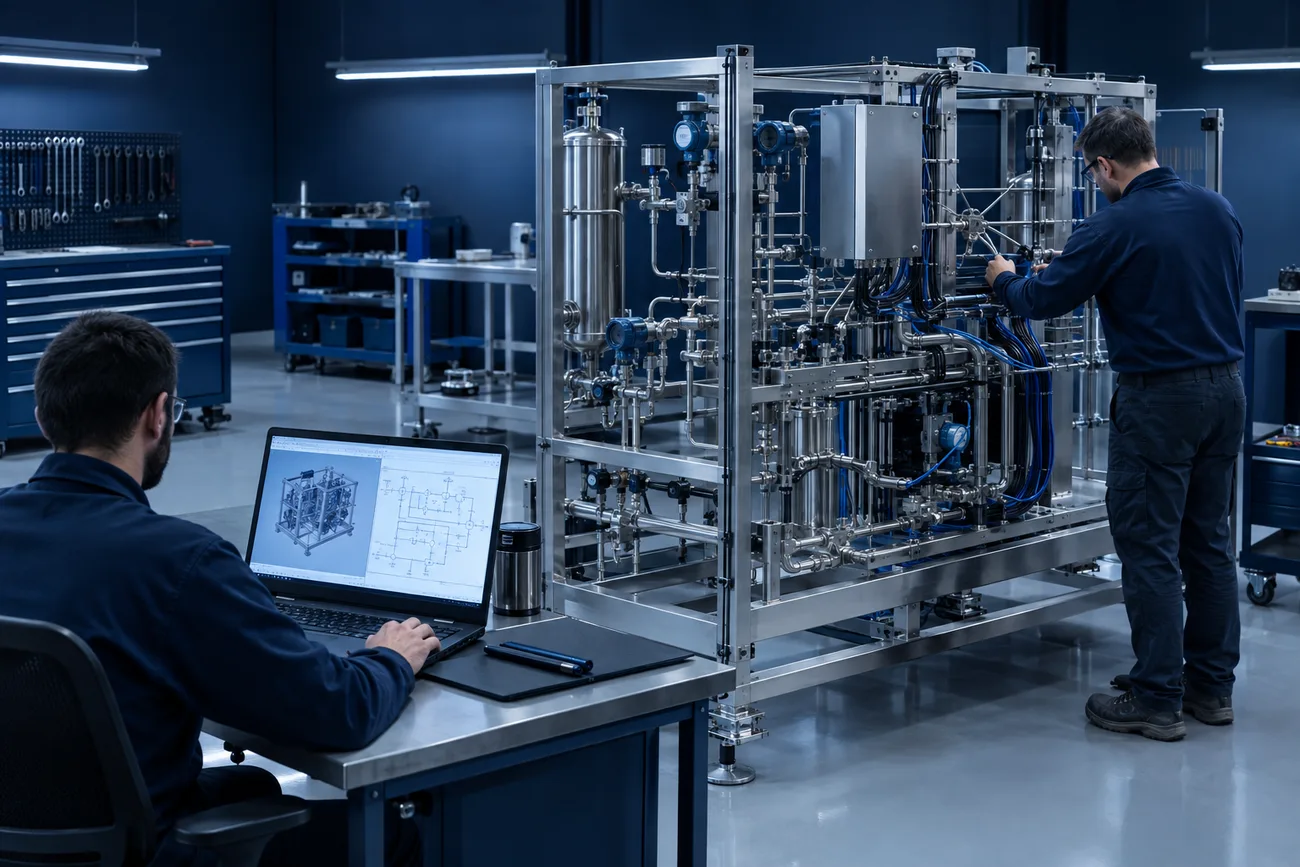
Two engineers building and instrumenting a custom stainless test stand in a shop
Engineering, fabrication, plumbing, and instrumentation handled by the same two people who quote the job. Representative configuration and workmanship standards.

Capabilities

One shop, requirement to acceptance data

01

Test stand modernization

Replace obsolete gauges, flowmeters, controls, and instrumentation while retaining the test capability you already rely on. We reverse-engineer existing equipment, rebuild the documentation, and add modern controls and data acquisition — for the bench whose manufacturer is gone, whose drawings are missing, and whose expert retired.

02

Flow measurement

Turbine, Coriolis, and laminar-element flow sections sized to your component and media, with repeatable flow-versus-Δp behavior for production acceptance.

03

Pressure and proof test

Regulated supply, intensifiers, burst shields, and proof, leak-decay, and cycle sequences with ramp and dwell control. Relief sizing and interlocks are part of the design, not an afterthought.

04

Functional test

Pressure-switch actuation and reset points, solenoid and actuator function, RPM, temperature, LVDT position, continuity and insulation checks — the electrical half of the acceptance procedure.

05

Fixtures and manifolds

Machined aluminum and stainless manifolds, adapter blocks, AN/MS and dynamic-seal interfaces, and quick-change tooling so one bench covers a family of part numbers.

06

Controls and data acquisition

PLC or embedded control, touchscreen sequencing, recipe per part number, and CSV/PDF test records that drop into your quality system instead of a clipboard.

07

Calibration hardware

Reference orifices, calibrated restrictors, master nozzles, and transfer standards — serialized and set up for re-certification on a schedule you control.

08

Field and line support equipment

Portable pressure and nitrogen carts, hydraulic mules, and ground support test sets built to survive a ramp instead of a lab bench.

Equipment

Built around the part, not a catalog page

Most benches on the market make your component fit their plumbing. We start from the component drawing, the acceptance procedure, and the throughput you need, then design the flow path, instrumentation, controls, and fixturing around it.

  • Component flow benches — fuel, oil, hydraulic, and pneumatic flow versus pressure.
  • Pressure test stands — proof, burst, cycle, and leak-decay with programmable profiles.
  • Functional test equipment — switch actuation, electrical function, position, speed, temperature.
  • Lubrication and oil rigs — heated turbine oil loops, filtration, and ΔP measurement.
  • Pneumatic and bleed-air rigs — heated air, mass-flow control, high-temperature instrumentation.
  • Fixtures and flow hardware — adapters, manifolds, orifice plates, metering restrictors, flow dividers.
  • Ground support sets — hydraulic mules, N₂ boost carts, portable leak testers.
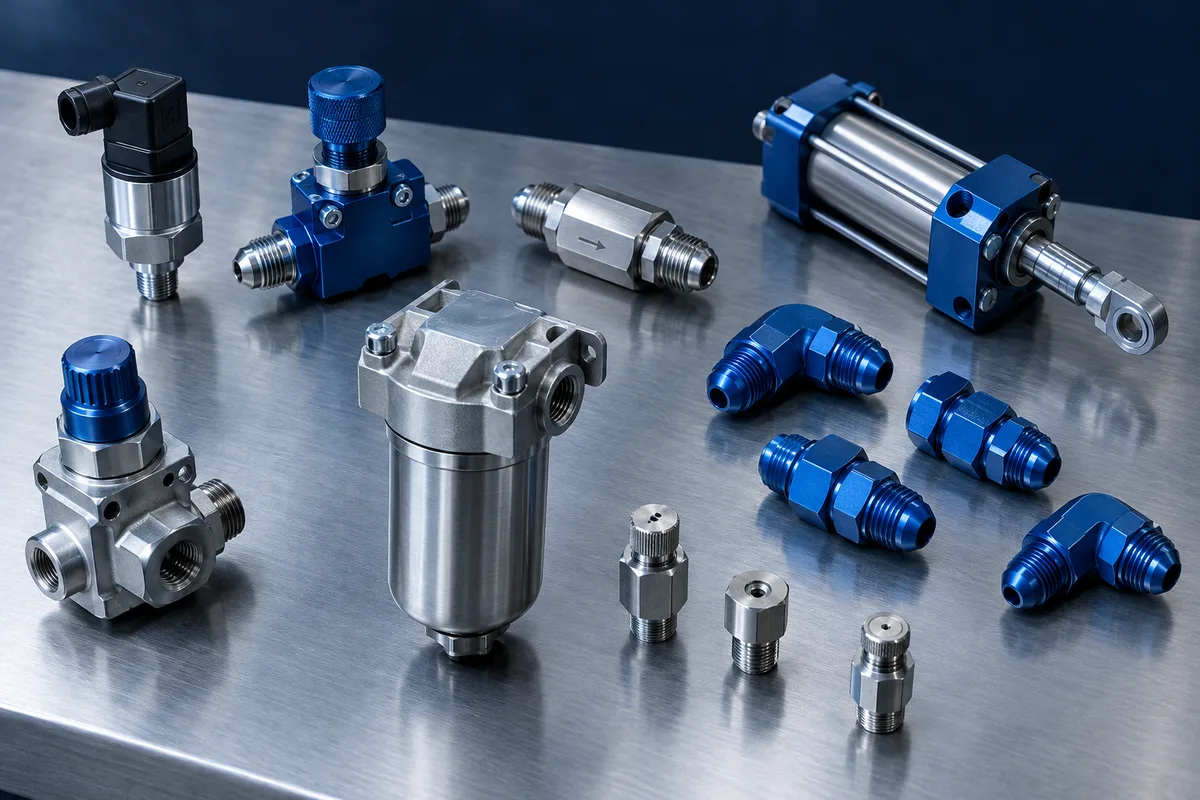
Aerospace valves, pressure switch, actuator, regulator, filter, and AN fittings laid out on a steel bench
Valves, switches, actuators, regulators, and filters — the kinds of components we build acceptance test equipment around.

Examples of what we can test

  • Pressure switches
  • Flow control valves
  • Check valves
  • Bypass valves
  • Pumps
  • Actuators
  • Regulators
  • Filters
  • Heat exchangers
  • Fuel components
  • Oil and lubrication components
  • Hydraulic components
  • Pneumatic components
  • Nozzles and orifices

Don't see your part? If it has a defined acceptance test, we can usually build the equipment for it. Send the procedure and we'll tell you straight whether it's a fit.

How to buy

Easy to put on a purchase order.

You don't have to commit to a full test system to start. Most customers begin with a small fixed-price engineering study, get a real scope and price out of it, then issue the build PO with the unknowns already removed.

Step 1 · start here

Test system study

Fixed price, one line item, one PO. Send the CMM or ATP and we return a scoped concept for the test system.

  • Requirements matrix built from your acceptance procedure
  • Concept flow schematic and instrumentation list
  • Controls and fixture approach
  • Budgetary price and schedule for the build

The study fee is credited against the build purchase order if you proceed.

Request a study quote
Step 2

Design package

Released P&ID, electrical schematic, fixture and panel drawings, bill of material, and control sequence — reviewable by your engineering group before any metal is cut.

Can be purchased on its own or rolled into the build.

Step 3

Build, FAT, and delivery

Firm fixed price against the released design, invoiced on milestones you can track: design release, long-lead procurement, assembly complete, FAT acceptance, delivery and SAT.

Acceptance is tied to the FAT criteria written into the quote — not to an opinion.

Working with your purchasing group

  • Quotes written for procurement — line-itemed scope, deliverables, exclusions, validity period, and payment milestones on one document.
  • Supplier onboarding handled — W-9, supplier information forms, terms acknowledgements, and certificate of insurance completed and returned on request.
  • POs submitted through your project portal — reference the quote number; we acknowledge in the portal with the schedule and milestone dates in writing.
  • Milestone invoicing — progress payments tied to defined deliverables, so nothing is billed before it exists.
  • Your documents, not ours — the drawing package, P&ID, schematics, BOM, and procedures are delivered to you so the equipment stays maintainable.
  • One point of contact — the engineer who scoped it is the one who answers your questions through delivery and after.

Specific commercial terms, warranty period, and lead times are set per project and stated on the quote.

Questions buyers ask first

How do I justify this internally?

Usually on repeatable acceptance time and scrapped-test risk: a bench that matches the procedure removes rework, argument over results, and the hours your engineers currently spend improvising a test setup. The study deliverable gives you the numbers to put in front of your manager.

Our CMM is vague or partly obsolete.

That's normal, and it's the part we're good at. We flag the ambiguous steps, propose a defensible interpretation, and get it agreed with your engineering authority before design release.

Can you work with the bench we already have?

Yes. Modernization is a large share of what we do — new instrumentation, controls, and data acquisition on existing equipment, including reverse-engineering the documentation that went missing.

Who owns the design and data?

You receive the complete documentation package for the equipment you paid for, so you can maintain, re-certify, and modify it without coming back to us for a drawing.

What happens after delivery?

Install support and SAT, operator training, a spares list, and a calibration and re-certification schedule. Support after that is a phone call, not a ticket queue.

Is there a minimum project size?

No. Fixtures, adapters, flow hardware, and single-function test sets are worth quoting, and they're often how a first purchase order gets written.

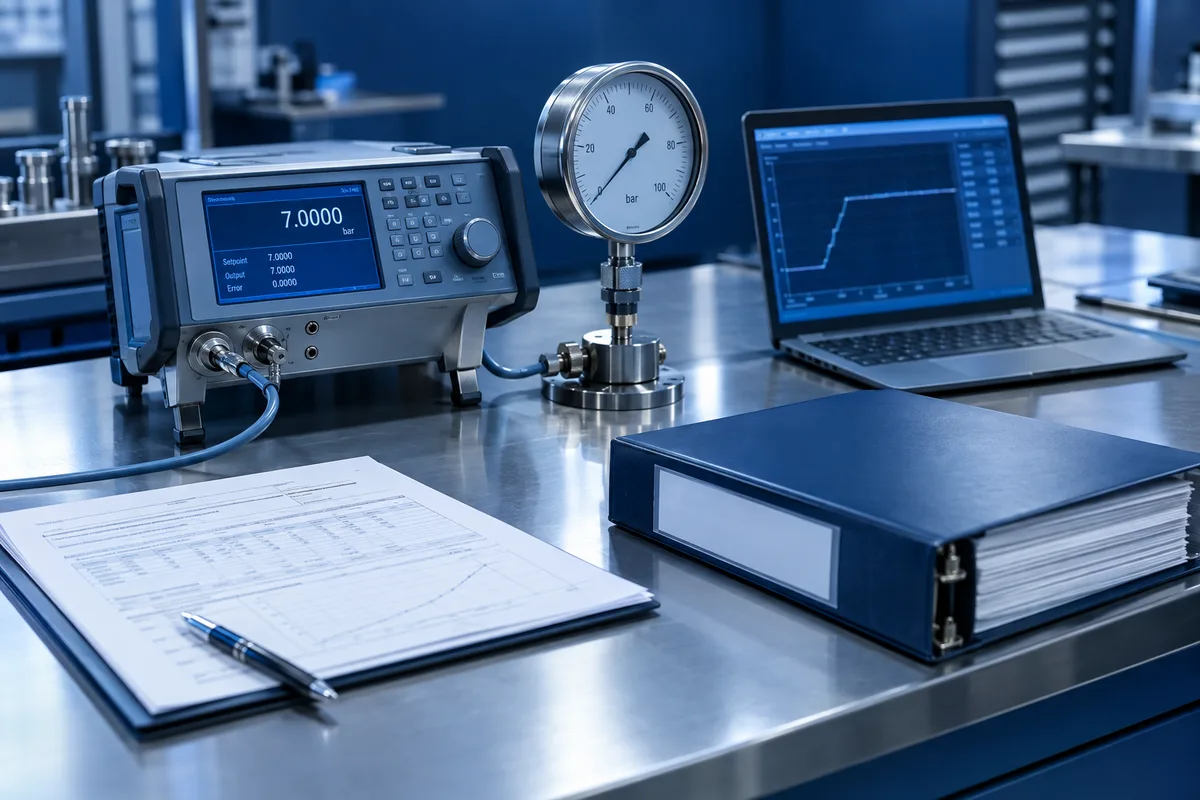
Pressure calibrator, reference gauge, data trace, and controlled document binder on a calibration bench
Instrumentation calibrated against traceable standards, with the certificates and records delivered as part of the document set.

Documentation

Documentation built for aerospace quality systems

Test equipment is only as good as the paperwork behind it. Each build ships with a controlled document set — drawings, P&ID, electrical schematic, bill of material, calibration requirements, FAT/SAT records, and operating limits — under a document-control numbering scheme that drops into your system.

Instrumentation is calibrated before delivery, with certificates supplied for each device. Where your quality system requires it, we route calibration through an ISO/IEC 17025-accredited laboratory with NIST-traceable standards and supply the accredited certificates with the build.

Controlled drawings P&ID and schematics Calibration certificates FAT / SAT records Relief sizing analysis Operator training Spares and re-cert plan

We build ground test and support equipment. Airworthiness approval for installed parts stays with the design-approval holder; we support your certification and quality path with test data and documentation, and work to your engineering authority's requirements.

Process

Four phases, fixed deliverables

  1. Phase 1

    Requirements

    We read the component spec, CMM, and ATP, then pin down media, ranges, accuracy needs, cycle time, and safety boundaries. You get a requirements matrix and a budgetary number.

  2. Phase 2

    Design

    P&ID, flow-path sizing, relief and burst analysis, instrument selection, panel and fixture CAD, control sequence narrative. You get a design review package and a firm price.

  3. Phase 3

    Build and verify

    Fabrication, machining, plumbing, wiring, and software, then FAT against your acceptance criteria with real hardware and recorded data. You get the FAT report and calibration certificates.

  4. Phase 4

    Install and sustain

    On-site SAT, operator training, spares kit, O&M manual. You get a calibration schedule and someone who answers the phone afterward.

Customer project portal

Your drawings, models, and test data in one place.

Every project gets a secure login. Engineering shares drawings, CAD models, reports, calibration certificates, and test data as the work moves. You can open CAD models in the browser, read PDFs without downloading them, and send us requirement files directly.

  • Each customer's files are walled off from every other customer's
  • Large CAD and PDF uploads resume if the connection drops
  • Built-in 3D viewer for STEP, STL, OBJ, glTF, 3MF, and PLY
  • Project status, PO reference, and messages with the engineering team

Who we build for

Built for the people who have to prove the part works.

Component MRO

Repair stations that need a bench matching the CMM flow, pressure, and functional steps exactly.

PMA and parts makers

Production acceptance rigs and reference hardware to show equivalence and hold tolerance.

OEM engineering

Development rigs for qualification, endurance, and environmental test campaigns.

Flight departments

Hangar-grade nitrogen, hydraulic, and leak-test carts sized to your fleet.

Defense and rotorcraft

Ruggedized test sets and adapters for field and depot-level maintenance.

Test labs

Calibrated flow sections and transfer standards to anchor your measurement chain.

Ready to put a test system on a PO?

Send the acceptance procedure. You'll get a scoped concept and a fixed-price study quote your purchasing group can process as a single line item.

Have a CMM or ATP?

Send it to us.

We'll review the test requirements, identify the equipment and instrumentation needed, and develop a concept for the test system. If it isn't a fit, we'll say so instead of quoting it.

  1. You describe the test in the form. A plain description is enough to start.
  2. Within two business days we set up your secure project portal. Upload the CMM, ATP, or drawings there, and we reply with clarifying questions and a fixed-price study quote.
  3. You issue one PO and get a scoped concept, instrumentation list, and budgetary build price.
  • CommunicationThrough your secure project portal: messages, files, quotes, and POs in one record
  • LocationTequesta, Florida, USA
  • ResponseWithin two business days
  • What to sendCMM or ATP pages, component drawing, media, ranges, throughput, and your target in-service date
  • ProcurementW-9, supplier forms, and certificate of insurance returned on request